Shelf VI · Booking Tips
Booking a small hotel: the six checks before you pay
A listing is a composition, not a description. Six checks, ten minutes, no tools beyond a map: the windows, the lift, the noise, the breakfast wording, the honest distance and the final figure in writing.
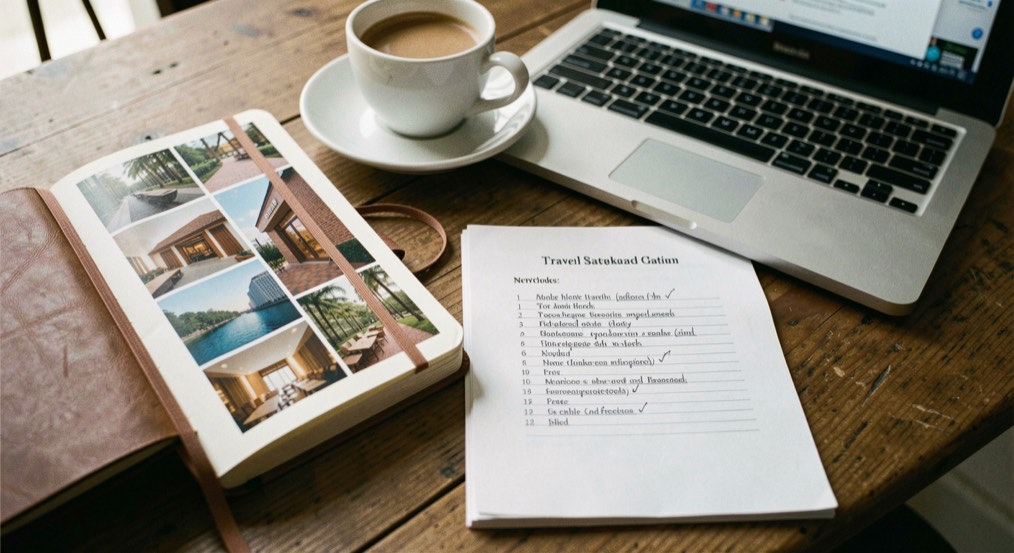
Every disappointing small hotel stay was written, in advance, in the listing. Not as a lie, as a composition: the photographs angled, the adjectives chosen, the facts arranged. Reading a listing honestly takes ten minutes and no tools beyond a map, and it reduces to six checks, run before any deposit in every note on this site.
One to three: the room itself
Windows are the first casualty of a renovation on a budget, and the photographs answer the question before the description does: a listing where every window is cropped, netted or blown out white is answering a question about light and noise that nobody asked aloud. The lift is worth about EUR 10 a night to anyone with a suitcase, and scrolling past the floor field is how a fourth floor walk up is born; the top floor under the roof adds an August heat premium of its own. Noise is the third room check: tram tracks, nightlife axes and market streets all publish their schedules through the glass at two in the morning, and the words courtyard, rear or side are the three most valuable in any description.
The wording does the confessing. City view, partial view and courtyard view are three different prices for three different rooms in the same house, and a listing that never says which room type the rate buys is selling the photograph, not the bed. A floor field left blank on a platform is not an oversight; it is the cheapest sentence the listing never had to write.Four to six: the price of the truth
Breakfast available and breakfast included describe the same table at different prices, and the gap runs EUR 8 to 12 a night across the continent; price the room both ways against the five mark scale before comparing rates. The honest distance is measured in walking minutes on a real map, never in the straight line metres of a platform: ten downhill minutes from a station is a different promise from the same ten back up with a suitcase. And the small print is the final figure: a city tax of EUR 2 to 5 a night belongs in the listing, and when it appears only at the desk, the house is managing the figure, a habit that extends.
The tax schedule is public in every city on this site: EUR 4 a night in Lisbon, EUR 2 in Porto, about four percent of the rate in Budapest, about five percent in Vienna, a tiered few euros in Bologna and a seasonal climate fee in Athens. None of them is optional; the only question is whether the listing does the arithmetic or leaves it to the desk.
The six checks, in one list
The whole method, printable on a card:
- Windows: every photograph examined for glass; the facing asked in writing.
- Lift and floor: the floor field read twice; the lift priced at ten euros a night.
- Noise: the street named, the reviews searched for it, the courtyard claimed.
- Breakfast wording: available or included, the room priced both ways.
- Distance: station to door in walking minutes, the gradient noted.
- Small print: rate, tax and breakfast in one written line before paying.
What each check protects
None of the six is speculative; each protects a cost with a number on it.
| Check | What skipping it costs | The counter move |
|---|---|---|
| Windows | A room over a tram corridor | Ask the facing, in writing |
| Lift and floor | A fourth floor walk up | Price the stairs at EUR 10 a night |
| Noise | Ruin bars until two | Courtyard, rear or side rooms |
| Breakfast wording | EUR 8 to 12 a night | Price the room both ways |
| Distance | A suitcase on cobbles | Walking minutes on a real map |
| Small print | The tax at the desk | One written line: rate, tax, breakfast |
One habit holds the six together: write the answers down before paying. The facing of the room, the floor, the street, the breakfast price, the walking minutes and the final figure, one line each, in the message that precedes the deposit. A house that answers all six lines is bookable; a house that answers four is telling the reader which two questions to ask twice.
Mistakes to avoid
The classic errors: trusting the star rating, which measures amenities and answers none of the six questions; reading reviews for sentiment instead of for street names, which is where the noise maps itself; booking the photograph instead of the room type, since most houses hold three kinds of window; and skipping the written line about the final figure because asking felt awkward, which is exactly what the tax at the desk is counting on. Houses that pass all six checks are the ones worth the deposit; the method is applied city by city from the where to stay shelf.